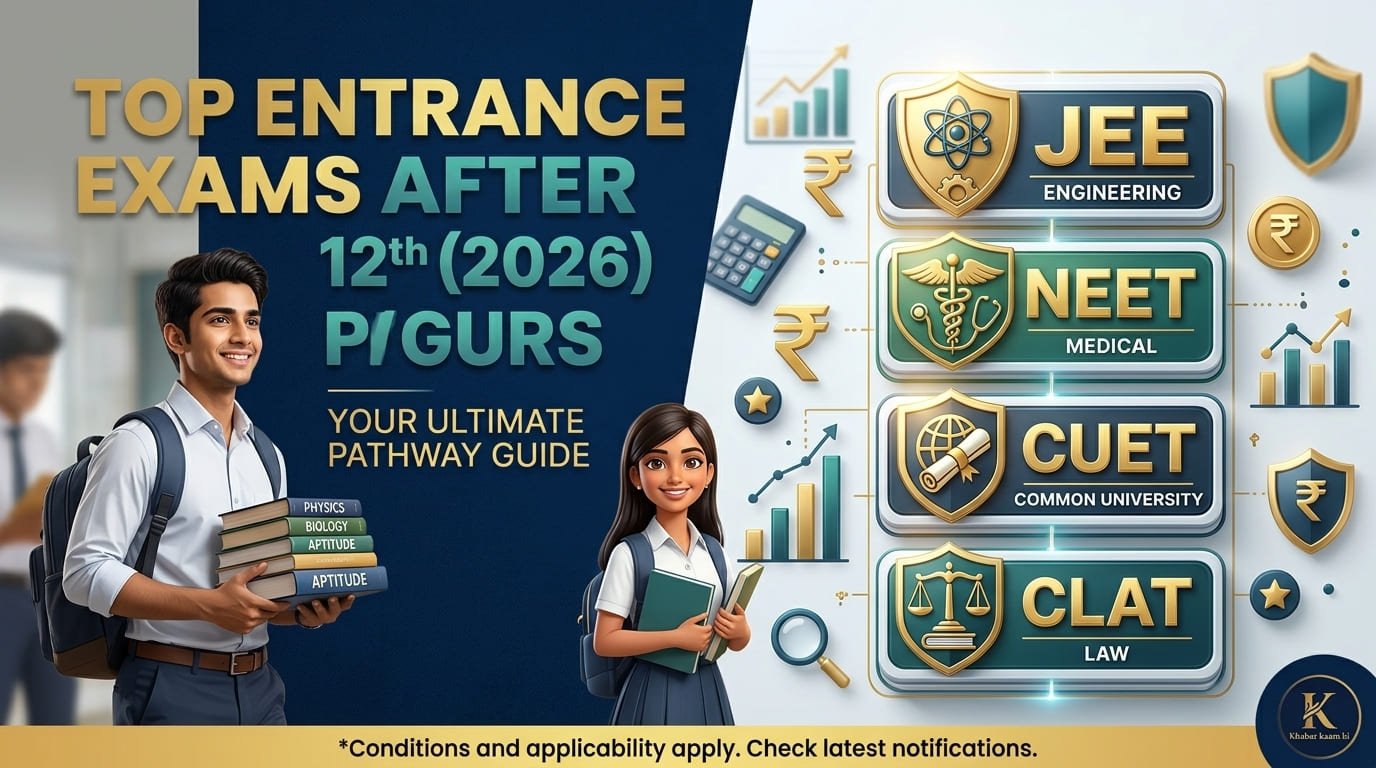
Top Entrance Exams After 12th in 2026: Navigating admissions after Class 12 requires a clear strategy. Top entrance exams in India for 2026 include JEE Main & Advanced for Engineering, NEET UG for Medical, CUET UG for Central Universities, CLAT for Law, CA Foundation for Commerce, and IPMAT for Management. Early preparation with NCERT coverage, structured mock tests, and tracking official NTA and university schedules are essential for securing seats in premier institutes.
Passing Class 12 board examinations is a major milestone, but for millions of students across India, the real gateway to higher education begins with competitive entrance exams. Whether you aim to join an IIT, get an MBBS seat, study at a National Law University (NLU), crack CA Foundation, or enter an Integrated IIM program, understanding the exam landscape is critical.
With testing bodies like the National Testing Agency (NTA) standardizing schedules, staying updated on exam patterns, eligibility, and timelines gives students a distinct competitive edge. This comprehensive guide covers the top entrance exams after 12th in 2026 across Science, Commerce, and Arts streams.
1. Top Entrance Exams After 12th in 2026: Overview of Top National Entrance Exams in India (2026)
Selecting the right entrance test depends on your stream (PCM, PCB, Commerce, or Arts) and target career goals.
List of Top Entrance Exams After 12th in 2026
| Exam Name | Stream / Field | Conducting Body | Target Institutes | Key Testing Format |
| JEE Main & Advanced | Engineering (PCM) | NTA / IITs | NITs, IIITs, CFTIs & IITs | CBT (MCQs + Numerical) |
| NEET UG | Medical & Dental (PCB) | NTA | AIIMS, JIPMER, Govt Medical Colleges | Pen & Paper (OMR) |
| CUET UG | All Streams (Arts, Science, Commerce) | NTA | DU, BHU, JNU & 200+ Central/State Varsities | Hybrid/CBT (Domain MCQs) |
| CLAT UG | Law (Any Stream) | Consortium of NLUs | 24+ National Law Universities | Offline Reading & Analytical Test |
| CA Foundation | Accounting & Finance (Commerce/Any) | ICAI | Professional CA Certification Track | Descriptive + Objective Papers |
| IPMAT | Management (Any Stream) | IIM Indore / IIM Rohtak | 5-Year Integrated IPM at IIMs | Computer-Based Aptitude Test |
| NIFT / NID DAT | Design & Fashion (Any Stream) | NTA / NID Ahmedabad | NIFT Campuses & NID Ahmedabad | Creative + Situation Test |
| NDA & NA | Defense Services (Science/Any) | UPSC | National Defence Academy (Army, Navy, Air Force) | Written Test + 5-Day SSB Interview |
2. Science Stream Exams: Engineering & Technology (PCM)
For students in the Physics, Chemistry, and Mathematics (PCM) combination, competitive exams open pathways into software development, artificial intelligence, robotics, aerospace, and core engineering branches.
A. JEE Main 2026 (Joint Entrance Examination – Main)
- Conducting Body: National Testing Agency (NTA)
- Frequency: Two sessions annually (Session 1 in January/February and Session 2 in April).
- Paper Structure: Paper 1 covers Physics, Chemistry, and Mathematics. It features 90 multiple-choice and numerical value questions for a total of 300 marks.
- Target Admissions: Qualifies candidates for admissions into National Institutes of Technology (NITs), Indian Institutes of Information Technology (IIITs), Centrally Funded Technical Institutes (CFTIs), and acts as the screening test for JEE Advanced.
B. JEE Advanced 2026
- Conducting Body: One of the zonal IITs on a rotating basis.
- Eligibility: Reserved strictly for the top 2.5 lakh rank-holders of JEE Main.
- Format: Consists of two mandatory 3-hour papers on the same day, testing deep analytical problem-solving skills in Physics, Chemistry, and Mathematics.

C. State & Institutional Engineering Exams
- BITSAT 2026: Online computer-based test conducted by BITS Pilani for admissions across its Pilani, Goa, and Hyderabad campuses. Includes sections on English Proficiency and Logical Reasoning alongside Physics, Chemistry, and Math.
- Top State CETs: MHT-CET (Maharashtra), KCET (Karnataka), WBJEE (West Bengal), AP EAMCET, and TS EAMCET grant entry into top state government engineering institutions.
3. Science Stream Exams: Medical & Allied Sciences (PCB)
Students taking Physics, Chemistry, and Biology (PCB) target medical, dental, and life-science paths.
A. NEET UG 2026 (National Eligibility cum Entrance Test)
- Conducting Body: National Testing Agency (NTA).
- Mandatory Gateway: The single national entrance test required for admission to MBBS, BDS, AYUSH (BAMS, BHMS, BUMS), BVSc (Veterinary Science), and B.Sc Nursing courses across India.
- Exam Pattern & Marking:
- 180 questions to be answered out of 200 questions across Physics, Chemistry, Botany, and Zoology.
- Maximum Marks: 720.
- Marking Scheme: +4 for correct answers, -1 for incorrect responses.
- Syllabus Baseline: Built 100% on Class 11 and Class 12 NCERT science textbooks.
B. ICAR AIEEA UG 2026 (Agriculture & Allied Sciences)
- Conducted for admissions to B.Sc (Hons) Agriculture, Forestry, Horticulture, and Community Science across ICAR-accredited agricultural universities.
4. Commerce & Finance Entrance Pathways
Commerce students have direct access to corporate governance, high-finance, audit, and administrative tracks.
| Stream / Domain | Key Entrance Exams & Professional Tests | Target Professional Careers / Courses |
| Accounting & Auditing | CA Foundation, CMA Foundation | Chartered Accountant (CA), Cost & Management Accountant (CMA) |
| Management | IPMAT, NPAT, SET | 5-Year Integrated BBA+MBA, Corporate Management, Business Leadership |
| Corporate Law & Secretarial | CLAT, CSEET | Corporate Lawyer, Company Secretary (CS), Legal Advisor |
A. CA Foundation (ICAI)
- Conducting Body: Institute of Chartered Accountants of India (ICAI).
- Overview: The first entry tier for becoming a Chartered Accountant (CA).
- Paper Breakdown: Four papers comprising Accounting, Business Laws, Quantitative Aptitude (Maths, Statistics, Logical Reasoning), and Business Economics.
B. CMA Foundation & CSEET
- CMA Foundation: Conducted by ICMAI for students pursuing Cost and Management Accounting.
- CSEET (Company Secretary Executive Entrance Test): Conducted by ICSI for candidates entering corporate law compliance and secretarial roles.
5. Multidisciplinary Pathways: Arts, Law, Management & Defense
One of the biggest advantages of modern competitive exams in India is that students from any stream (Science, Commerce, or Arts) can compete for law, management, design, and defense seats.
A. CUET UG 2026 (Common University Entrance Test)
- Significance: Standardized national test for central universities (like Delhi University, BHU, JNU, Jamia Millia) and over 200 state, deemed, and private universities.
- Exam Structure:
- Section I (Languages): Tests reading comprehension, vocabulary, and literary aptitude.
- Section II (Domain Subjects): Choose from domain-specific subjects aligned with Class 12 subjects.
- Section III (General Test): General Knowledge, Current Affairs, Mental Ability, Numerical Quantitative Reasoning.
B. CLAT UG 2026 (Common Law Admission Test)
- Conducting Body: Consortium of National Law Universities.
- Programs Offered: 5-Year Integrated BA LLB, BBA LLB, B.Com LLB, and B.Sc LLB.
- Exam Pattern: A 120-minute comprehension-based offline exam consisting of 120 questions across five sections:
- English Language
- Current Affairs including General Knowledge
- Legal Reasoning
- Logical Reasoning
- Quantitative Techniques
C. IPMAT 2026 (Integrated Programme in Management)
- Conducting Institutes: IIM Indore and IIM Rohtak. Scores are also accepted by IIM Ranchi, IIM Jammu, and IIM Bodh Gaya.
- Unique Benefit: Allows students to secure a 5-year BBA+MBA seat at an IIM right after high school without appearing for CAT later.
- Testing Areas: Quantitative Ability (Multiple Choice & Short Answer) and Verbal Ability.
D. UPSC NDA & NA Examination
- Conducting Body: Union Public Service Commission (UPSC).
- Selection Process: Written Examination (Mathematics + General Ability Test) followed by a intensive 5-day SSB (Services Selection Board) interview and medical evaluation.
6. Strategic Month-by-Month Preparation Framework
| Phase | Timeline | Core Focus Area | Key Activities & Objectives |
| Phase 1 | Months 1–6 | NCERT & Concept Foundation Building | Build complete clarity on concepts using NCERT textbooks for Science and Humanities subjects. For law and management, start daily reading habits to build vocabulary and reading speed. |
| Phase 2 | Months 7–9 | Topic Quizzes & PYQ Solving | Solve at least 5 to 10 years of chapter-wise previous exam questions (PYQs) to identify weightage patterns, recurring concepts, and weak areas. |
| Phase 3 | Months 10–12 | Full Mock Exams & Mistake Analysis | Take full-length timed mock tests matching exact exam hours to build test stamina. Maintain an “Error Notebook” to log calculation mistakes, conceptual slips, or time-management delays. |
Success in national-level entrance exams relies on systematic study planning rather than last-minute cramming.
- Phase 1: Concept Mastery (NCERT First)
- Build complete clarity on concepts using NCERT books for Science and Humanities subjects. For law and management, start daily reading habits to build vocabulary and reading speed.
- Phase 2: Chapter-Wise Previous Year Questions (PYQs)
- Solve at least 5 to 10 years of chapter-wise previous exam questions to identify weightage patterns and recurring concepts.
- Phase 3: Timed Mock Tests & Error Tracking
- Take full-length timed mock tests matching exact exam hours to build test stamina. Keep an “Error Notebook” to log calculation mistakes, conceptual slips, or time-management delays.
Frequently Asked Questions (FAQs)
Q1. Is CUET mandatory for all college admissions in India?
While CUET UG is mandatory for central universities (like DU, BHU, and Jamia Millia Islamia) and many participating state and private universities, several state and autonomous colleges still conduct their own entrance tests or admit students based on 12th board marks.
Q2. Can Commerce or Arts students give competitive Top Entrance exams after 12th in 2026 ?
Yes. Stream restrictions do not apply to many top entrance exams. Students from Commerce or Arts can take CLAT (Law), IPMAT (Management), CUET UG (Humanities/Commerce), CA Foundation, and design exams like NIFT/NID.
Q3. What is the difference between JEE Main and JEE Advanced?
JEE Main is the qualifying exam for entry into NITs, IIITs, and state engineering institutions. Only the top 2.5 lakh candidates who clear JEE Main qualify to take JEE Advanced, which is the sole gateway for admissions into the IITs.
Disclaimer: Exam dates, application windows, negative marking rules, and syllabus structures are subject to official notifications issued by testing agencies (NTA, UPSC, ICAI, Consortium of NLUs). Aspirants should cross-check details on official portals before submitting application forms.