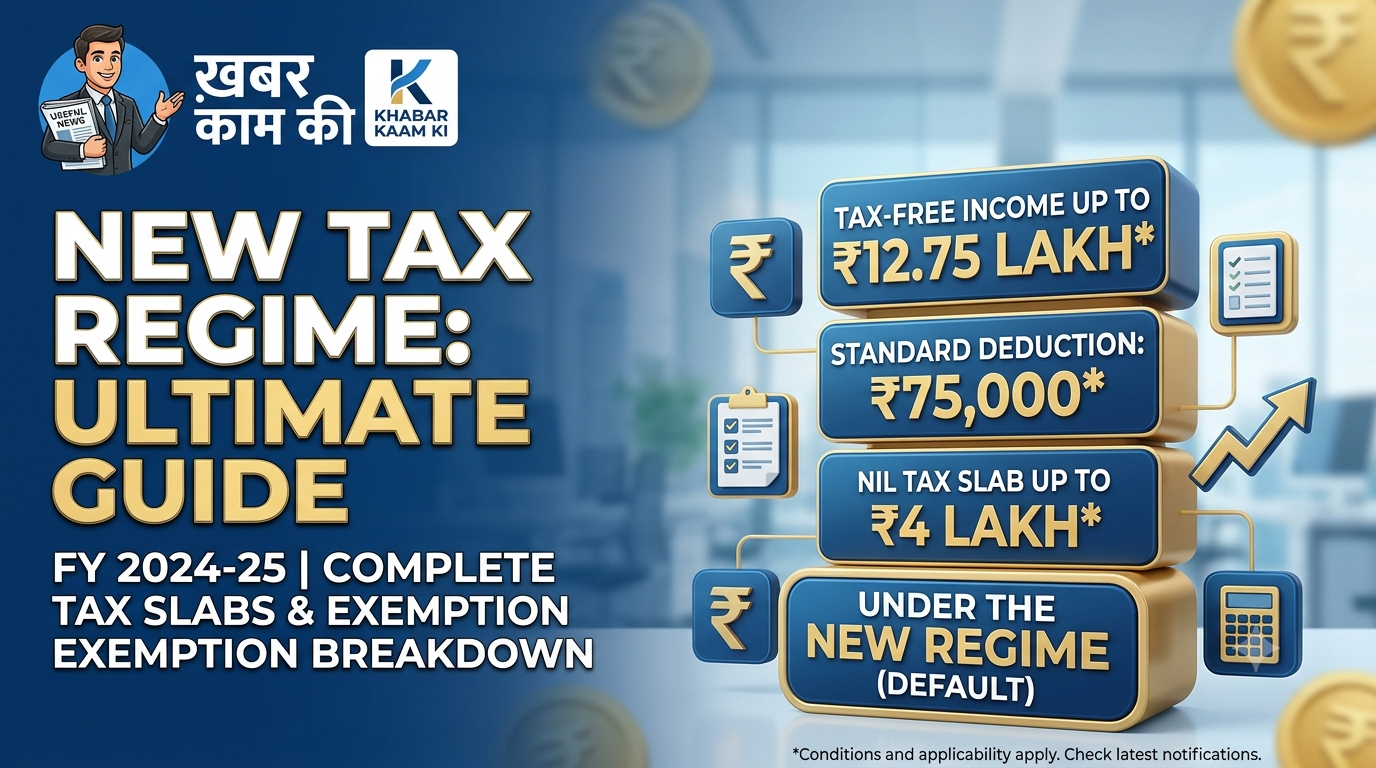
Under the modern New Tax Regime, taxable income up to ₹4 Lakh attracts a 0% tax rate. Thanks to an enhanced Section 87A rebate (covering taxable income up to ₹12 Lakh) and a flat ₹75,000 Standard Deduction for salaried employees and pensioners, gross annual incomes up to ₹12.75 Lakh are entirely tax-free.
Navigating personal finance in India requires a firm understanding of tax structures. With the New Tax Regime serving as the default tax framework for individual taxpayers, the rules of tax planning have shifted. Gone are the days when you scrambled at the last minute to lock in ₹1.5 Lakh under Section 80C just to lower your tax liability. Instead, the focus has shifted to streamlined slabs, lower baseline rates, and specialized deductions.
This exhaustive guide breaks down the New Tax Regime slab structure, marginal relief, allowed deductions, and actionable calculation strategies to help you optimize your take-home pay legally and efficiently.
1. What is the New Tax Regime?
Introduced to simplify tax filing and reduce overall compliance friction, the New Tax Regime (governed under Section 115BAC of the Income Tax Act) offers a lower, more progressive slab rate structure across wider income tiers.
The fundamental trade-off of the New Tax Regime is simple:
- The Benefit: Lower tax rates across expanded slabs and minimal paperwork.
- The Cost: You must let go of traditional deductions and exemptions like Section 80C (PPF, ELSS, life insurance), Section 80D (health insurance), House Rent Allowance (HRA), and Leave Travel Allowance (LTA).
However, because the basic exemption limits and tax rebates have grown substantially, most middle-class earners with moderate or zero traditional investments save significantly more under the new framework.
2. Complete Income Tax Slabs Under the New Regime
Unlike the old regime—which segregates taxpayers by age brackets (below 60, senior citizens, and super senior citizens)—the New Tax Regime Slabs applies a uniform set of tax slabs to all resident individuals.
| Taxable Income Bracket (in ₹) | Tax Rate Applicable |
|---|---|
| Up to ₹4,00,000 | Nil (0%) |
| ₹4,00,001 to ₹8,00,000 | 5% |
| ₹8,00,001 to ₹12,00,000 | 10% |
| ₹12,00,001 to ₹16,00,000 | 15% |
| ₹16,00,001 to ₹20,00,000 | 20% |
| ₹20,00,001 to ₹24,00,000 | 25% |
| Above ₹24,00,000 | 30% |
3. Demystifying the ₹12.75 Lakh Zero-Tax Threshold for Salaried Individuals
A major point of confusion for taxpayers is how an individual earning over ₹12 Lakh can end up paying zero income tax. This is achieved through a combination of two specific provisions: the Standard Deduction and the Section 87A Tax Rebate.
A. The Standard Deduction (₹75,000)
All salaried employees and pensioners are entitled to a flat, unconditional deduction of ₹75,000 straight off their gross salary. You do not need to present investment proofs, bills, or rent receipts to claim this.
B. Section 87A Tax Rebate (Up to ₹60,000)
For resident individuals whose total taxable income does not exceed ₹12,00,000, a direct tax rebate of up to ₹60,00,00 is applied. Because the total tax calculated on a taxable income of ₹12 Lakh equals exactly ₹60,000, the rebate wipes out the entire tax liability.
Mathematical Proof: Gross Salary of ₹12,75,000
Let’s look at how a salaried professional earning ₹12,75,000 pays zero tax:
- Gross Annual Salary: ₹12,75,000
- Less Standard Deduction: -₹75,000
- Net Taxable Income: ₹12,00,000
Now, applying the tax slab rates on ₹12,00,000:
- 0 to ₹4,00,000: Nil (₹0)
- ₹4,00,001 to ₹8,00,000 (5% on ₹4 Lakh): ₹20,000
- ₹8,00,001 to ₹12,00,000 (10% on ₹4 Lakh): ₹40,000
- Total Tax Before Rebate: ₹60,000
- Less Section 87A Rebate: -₹60,000
- Net Tax Payable: ₹0 (plus 4% Health & Education Cess on zero = ₹0)
4. What Deductions and Exemptions Are Still Allowed?
While the New Tax Regime Slabs does away with popular old-regime write-offs like 80C, 80D, and HRA, it is not completely stripped of exemptions. The following allowances and deductions can still be claimed:
- Standard Deduction: ₹75,000 for salaried individuals and pensioners.
- Employer’s Contribution to NPS (Section 80CCD(2)): Up to 14% of basic salary + DA for state/central government and private sector employees can be deducted from taxable income.
- Family Pension Deduction: Lower of ₹25,000 or 1/3rd of the total family pension received under Section 57(iia).
- Transport Allowance for Differently-Abled Employees: Exempt up to specified statutory limits.
- Conveyance & Official Tour Allowances: Daily allowances or travel grants spent strictly for official business duties.
- Gifts up to ₹50,000: Received from non-relatives within a financial year.
5. Marginal Relief: What Happens If Your Income Crosses ₹12 Lakh?
Under normal conditions, if your net taxable income exceeds ₹12 Lakh, you lose the Section 87A rebate entirely. However, Marginal Relief protects taxpayers whose net taxable income slightly exceeds ₹12,00,000 (up to approximately ₹12,70,588).
Under marginal relief rules:
$$\text{Tax Payable} = \text{Taxable Income} – ₹12,00,000$$
This ensures that the tax payable does not exceed the extra income earned over ₹12 Lakh. Once taxable income exceeds ₹12,70,588, normal slab rates apply in full without any marginal relief.
6. Old Tax Regime vs. New Tax Regime: Quick Comparison
To help you decide which side of the fence your financial profile fits on, review this side-by-side comparative breakdown:
| Feature / Parameter | New Tax Regime (Default) | Old Tax Regime |
|---|---|---|
| Basic Exemption Limit | Uniform ₹4,00,000 | ₹2,50,000 (General) / ₹3,00,000 (Seniors) |
| Standard Deduction | ₹75,000 | ₹50,000 |
| Max Tax Slab Rate | 30% (Above ₹24 Lakh) | 30% (Above ₹10 Lakh) |
| Section 87A Rebate Limit | Up to taxable income of ₹12 Lakh (Max Rebate ₹60,000) | Up to taxable income of ₹5 Lakh (Max Rebate ₹12,500) |
| Deductions (80C, 80D, HRA) | Not Permitted | Fully Permitted (Up to limits) |
| Ideal For | Taxpayers seeking simplicity with low traditional investments | Homeowners paying heavy home loan interest & high 80C/80D investments |
Frequently Asked Questions (FAQs)
Q1. Is it mandatory to choose the New Tax Regime permanently?
No. While the New Tax Regime is the default option when filing your returns, salaried individuals generally have the flexibility to switch between the old and new regimes annually depending on which yields a lower tax liability. However, individuals with business or professional income face stricter restrictions when switching back and forth.
Q2. Can I claim home loan interest (Section 24) under the New Tax Regime?
Interest on a self-occupied property house loan cannot be claimed under the New Tax Regime. However, if you have a let-out (rented out) property, the interest paid on the home loan can be offset against rental income under the head “Income from House Property” without standard ceiling restrictions.
Q3. How do capital gains interact with the Section 87A rebate?
The Section 87A rebate under the new regime applies to normal-rate income. It cannot be used to offset tax liabilities arising from special-rate equity capital gains such as Short-Term Capital Gains (STCG) under Section 111A or Long-Term Capital Gains (LTCG) under Section 112A.