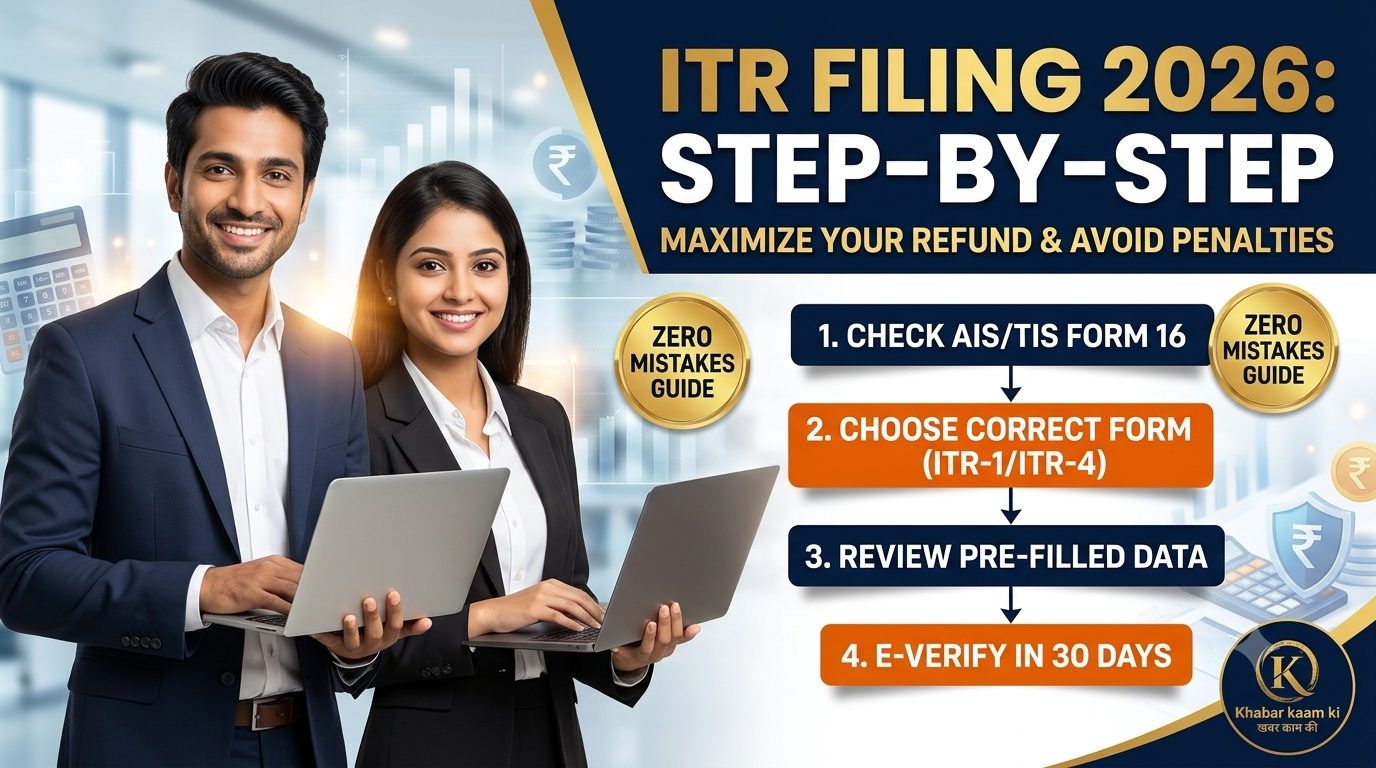
(ITR) Filing Guide 2026: Filing your Income Tax Return (ITR) accurately and on time is crucial to claiming tax refunds and maintaining legal compliance. Choosing the correct ITR form (such as ITR-1 or ITR-4), cross-verifying your data with your Annual Information Statement (AIS), and e-verifying your return within 30 days are essential steps to avoid defective return notices and late penalties.
Navigating the Indian tax filing system can feel daunting, but it doesn’t have to be. Whether you are a salaried professional receiving a monthly paycheck, a pensioner, or a growing freelancer, understanding how the pieces fit together on the e-filing portal ensures you claim your rightful refunds safely, quickly, and without administrative errors.
With the Income Tax Department continuously upgrading its pre-filled data systems, filing your return correctly is easier than ever—provided you know what forms to select and how to verify your financials. This comprehensive guide walks you through the entire process, optimized for accuracy and compliance.
1. Which ITR Form Should You File? (Crucial Step)
Choosing the correct ITR form is the single most important step in the filing process. Selecting the wrong form can flag your return as defective under Section 139(9), delaying your refund and triggering automated notices.
| ITR Form | Who is it for? | Key Income Sources Allowed |
| ITR-1 (Sahaj) | Resident individuals with simple income profiles | Salary/pension, income from up to two house properties, and other sources (interest, family pension) with total income up to ₹50 Lakh. |
| ITR-2 | Individuals and HUFs with diversified investments | Capital gains (stocks, mutual funds, property), more than two house properties, foreign assets/income, or holding directorship in a company. |
| ITR-3 | Individuals and HUFs running businesses or professions | Income from proprietary business or professional practice (not under presumptive schemes). |
| ITR-4 (Sugam) | Small business owners & freelancers | Presumptive business/professional income under Sections 44AD, 44ADA, or 44AE with total income up to ₹50 Lakh. |
2. Essential Documents to Keep Ready Before You Begin
Before logging into the e-filing portal, assemble these documents to cross-verify pre-filled numbers and avoid discrepancies:
- PAN & Aadhaar Card: Ensure your Aadhaar is actively linked to your PAN and your mobile number is linked to Aadhaar for OTP verification.
- Form 16: Issued by your employer; details your salary break-up, allowances, deductions, and Tax Deducted at Source (TDS).
- Annual Information Statement (AIS) & Tax Information Statement (TIS): Downloadable directly from the e-filing portal. These capture your high-value financial transactions, stock trades, mutual fund redemptions, savings bank interest, and dividend payouts.
- Form 26AS: Your consolidated tax passbook reflecting taxes deposited against your PAN by employers, banks, or other entities.
- Bank Interest Certificates: Savings account interest certificates and fixed deposit (FD) interest certificates for accurate income reporting.
3. Step-by-Step Walkthrough to File Your ITR Online – ITR Filing Guide 2026
Follow this structured workflow to file your return smoothly on the official Income Tax portal:
- Log In to the Portal: Go to the official e-filing portal (
incometax.gov.in) using your PAN as the user ID, your secure password, and the captcha code. - Navigate to File Returns: Hover over the ‘e-File’ menu, select ‘Income Tax Returns’, and click on ‘File Income Tax Return‘.
- Select Assessment Year: Choose the correct Assessment Year (AY) for the income earned during the relevant financial year.
- Choose Filing Status & Form: Select your status (e.g., Individual) and choose the appropriate ITR form (e.g., ITR-1) based on your income profile.
- Review Pre-filled Data: The portal automatically populates details from your Form 16, Form 26AS, and AIS. Crucial Rule: Cross-verify bank interest, dividend income, and capital gains against your AIS to prevent mismatch notices.
- Select Tax Regime: Confirm whether you are opting for the default New Tax Regime or switching to the Old Tax Regime depending on what minimizes your liability.
- Compute & Submit: Review the tax computation sheet. If any tax is due, pay it online via net banking or UPI and quote the Challan details. Finally, preview, sign, and submit your return.
4. The Golden Rule: Don’t Forget E-Verification of ITR Filing Guide 2026:
Your filing process is incomplete until you e-verify your return. You must e-verify within 30 days of submission:
- Modes of E-Verification:
- Aadhaar OTP (fastest and most convenient)
- Net Banking electronic verification code
- Electronic Verification Code (EVC) generated through your bank account
- Physical ITR-V signed and mailed via Speed Post to CPC Bengaluru (if digital options are unavailable).
- Note: Failing to e-verify within the stipulated 30-day window means your return is treated as legally invalid or not filed at all, inviting late penalties and interest.
5. ITR Filing Guide 2026: Common ITR Filing Mistakes to Avoid
To ensure your return is processed seamlessly without generating scrutiny notices, watch out for these frequent pitfalls:
- Mismatched Interest Income: Forgetting to report savings account or fixed deposit interest. The Income Tax Department cross-checks every rupee through your AIS.
- Choosing the Wrong ITR Form: Filing ITR-1 when you have capital gains from stock trading (which requires ITR-2).
- Incorrect Bank Account Details: Providing outdated bank account numbers or failing to pre-validate your account, which delays your tax refunds.
- Ignoring Exempt Incomes: Failing to report exempt incomes (like PPF interest or long-term capital gains within threshold limits) in the exempt income schedule.
Frequently Asked Questions (FAQs)
Q1. What happens if I miss the standard due date?
If you miss the original due date (typically July 31 for individuals not subject to tax audit), you can still file a Belated Return. However, late fees under Section 234F apply (₹1,000 if total income is under ₹5 Lakh, and ₹5,000 if it exceeds ₹5 Lakh) along with penal interest on unpaid taxes under Sections 234A, 234B, and 234C.
Q2. Can I correct errors after submitting my ITR?
Yes. If you spot an omission, numerical error, or missed deduction after successfully filing and e-verifying your return, you can file a Revised Return under Section 139(5) before the statutory cutoff date of March 31 of the relevant assessment year.
Q3. Is it mandatory to link PAN with Aadhaar for filing ITR?
Yes, linking your PAN with Aadhaar is mandatory. If your PAN and Aadhaar are not linked, your PAN becomes inoperative, preventing you from filing your ITR, claiming refunds, or conducting high-value financial transactions.
Conditions and applicability of the tax rules discussed apply. Tax laws and exemption limits are subject to change. This detailed ITR filing guide 2026 provides a comprehensive, step-by-step ITR filing process to assist taxpayers in how to file ITR online. However, tax calculations and liabilities vary. For precise tax planning and advice based on your specific financial situation, always check latest official notifications or consult a certified chartered accountant.